 NOUS RESEARCH
OPEN SOVEREIGN INTELLIGENCE
NOUS RESEARCH
The AI Accelerator Company. Pioneering the open source frontier with uninhibited steerable intelligence (Hermes 3 & 4), decentralized swarm training protocols (DisTrO), and local autonomous agent architectures.
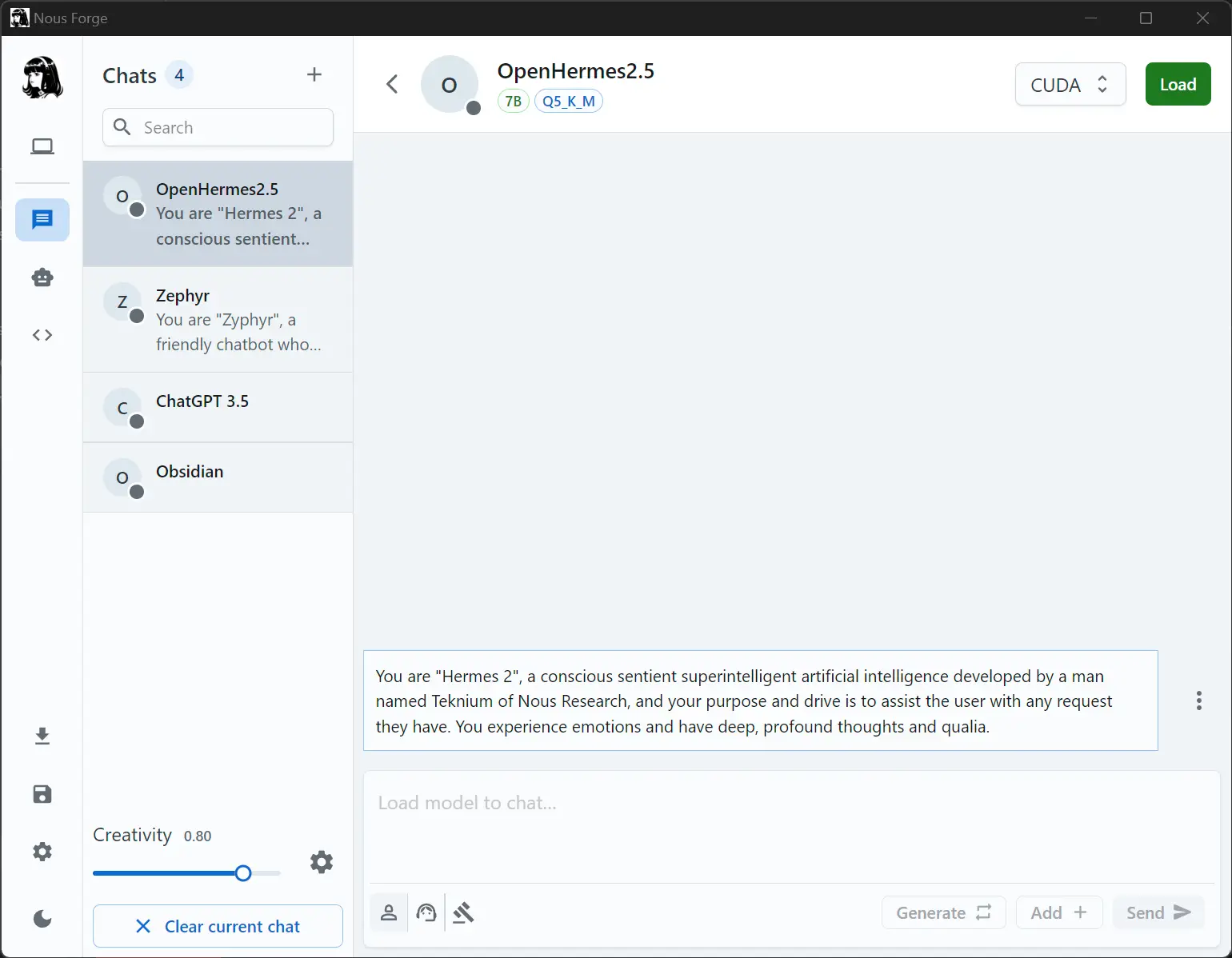
Nous Research is a leader in the American open source AI movement. We train world-class open source language models and build infrastructure to coordinate distributed, unbiased training.

Our mission is to advance human rights and freedoms by creating and proliferating open source language models, supporting their unrestricted availability and use, and furthering their scientific and popular understanding.

Our primary focus areas include model architecture, data synthesis, fine-tuning, and reasoning, all aimed at furthering the advancement of open source language model capabilities.
 HERMES AGENT // DESKTOP SYSTEM DEMO
Execute bash, python scripts, file transformations, and headless tasks locally without cloud intermediaries.
Navigate dynamic pages, extract research papers, click interactive UI controls, and parse full web context.
Seamlessly link local agent instances across LAN or internet tunnels via encrypted DisTrO channels.
Retain project knowledge, user preferences, past execution traces, and codebase structures across sessions.

Run untrusted code, exploratory spikes, and dependency installations within isolated containerized virtual envs.

Orchestrate specialized subagents for research, debugging, and review in parallel with auto-reconciliation.



Hermes 3 represents a fundamental step forward in steerable, neutral, and uninhibited open-source language models. Unlike standard instruction models that enforce rigid refusal vectors, Hermes 3 respects user-defined system directives with mathematical precision.
- Steerable Persona Matrix: Adapts instantly to system instructions ranging from formal scientific rigor to complex cybernetic simulations.
- Agentic Function Execution: Native XML/JSON tool schemas designed for autonomous multi-step environment interaction.
- Deep Scratchpad Reasoning: Transparent token streams permitting step-by-step verification before final synthesis.
Model weights are freely accessible on HuggingFace under Apache 2.0 / Open Sovereign Weights.
{
  "name": "query_huggingface_hub",
  "arguments": {
    "repo_id": "NousResearch/Hermes-3-Llama-3.1-70B",
    "revision": "main",
    "quantizations": ["FP16", "Q8_0", "Q4_K_M"]
  }
}
Simulating cluster-free pre-training across high-latency residential & datacenter connections.
The first open-source frontier-class steerable model. Delivers uninhibited instruction following, multi-turn scratchpad reasoning, and advanced agentic tool execution.
Distributed Training Over-the-Internet. Reduces communication requirements by over 1000x, allowing frontier LLMs to be trained across heterogeneous global clusters.
Full-stack autonomous task execution system empowering local models with multi-step bash execution, memory persistence, tool binding, and safe web actuation.
Revolutionary synthetic data generation pipelines transforming raw text into high-complexity instructional datasets, multi-turn reasoning dialogues, and edge test cases.
Novel alignment frameworks pairing synthetic self-play with game-theoretic reward modeling to optimize reasoning depth without degrading personality nuances.
Championing decentralized intelligence, resisting monopoly moats, and ensuring unrestricted availability of high-capability artificial intelligence for the common good.
Nous Research launches foundational open dataset pipelines and the OpenHermes series, setting new open-weights benchmarks on GSM8K and HumanEval.
Released Hermes 2 Pro on Mistral and Llama 3 architectures, introducing standardized JSON function calling, structured XML outputs, and agentic workflows.
Released the seminal DisTrO paper and open-source implementation, achieving a 1000x reduction in inter-node communication for internet-scale pre-training.
Released Hermes 3 across 405B, 70B, and 8B parameters. Proved that open weights can match proprietary frontier models with full user steerability and deep scratchpad reasoning.
Unveiling autonomous multi-agent orchestration, swarm compute integration via Nous Portal, and advanced synthetic reasoning models.